Career Guidance
SAP FICO vs. SAP MM: Which Module is Right for Your Career as a Fresher?
Embarking on an SAP career as a fresher can be both exciting and daunting, especially when faced with the choice between prominent modules like SAP FICO and SAP MM. Many freshers find themselves asking, "I am a fresher and confused whether to do SAP FICO or SAP MM training to get a new career?" This article aims to clarify the distinctions between these two critical SAP modules, helping you make an informed decision for your professional journey.
Your choice will largely depend on your interests, academic background, and long-term career goals. Both SAP FICO and SAP MM offer robust career paths within the vast SAP landscape, but they cater to different core business functions. Understanding their unique focuses is the first step in aligning your aspirations with the right module.
What is SAP FICO and What Does it Cover?
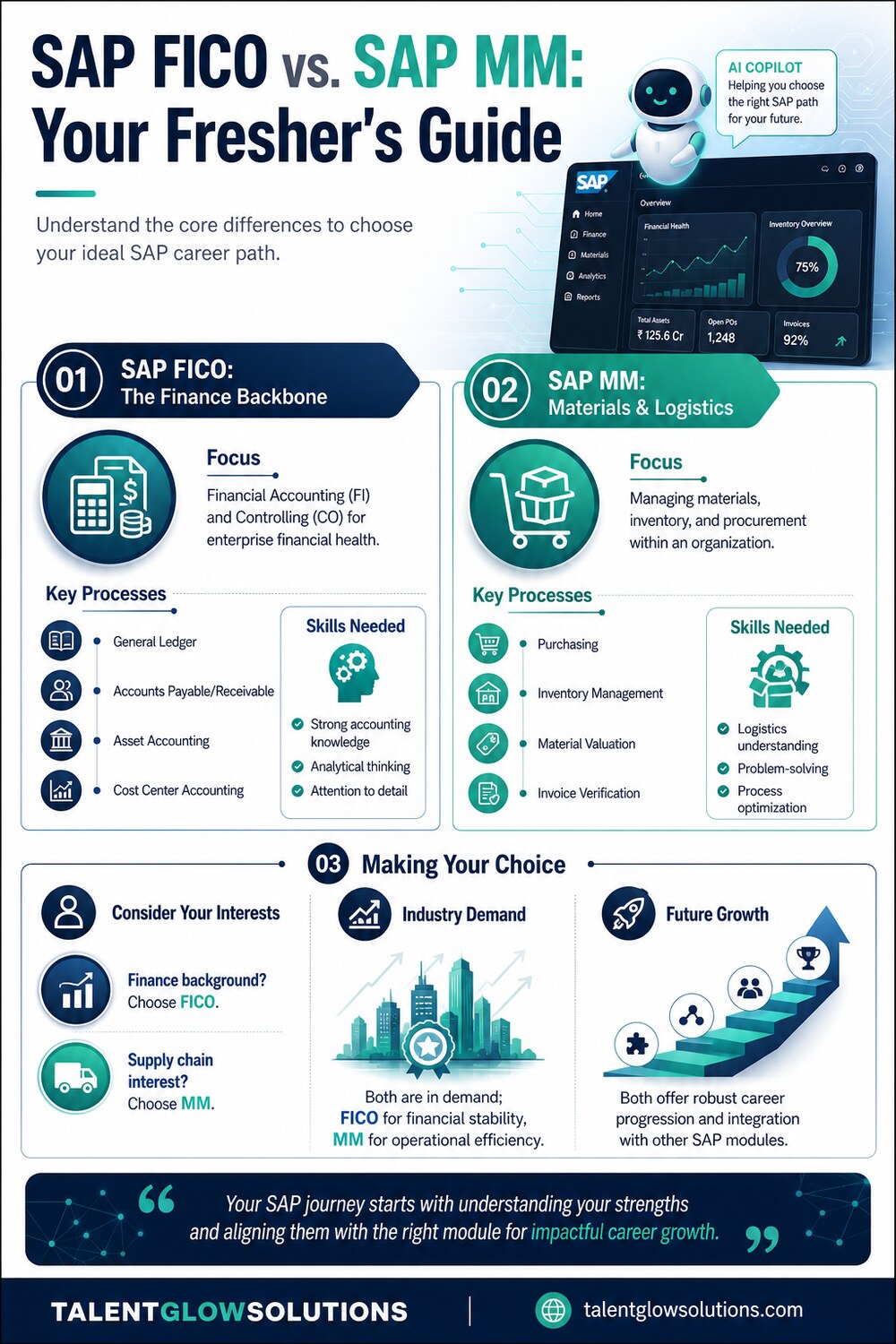
SAP FICO stands for Financial Accounting (FI) and Controlling (CO), serving as the backbone for an organization's financial operations. This module is essential for managing financial transactions, reporting, and cost analysis within a company. It ensures accurate financial data, which is crucial for decision-making and compliance.
SAP FI deals with external reporting, focusing on general ledger, accounts payable, accounts receivable, and asset accounting. SAP CO, on the other hand, concentrates on internal reporting, including cost center accounting, profit center accounting, and product costing. Together, they provide a comprehensive view of a company's financial health.
What is SAP MM and What Does it Cover?
SAP MM stands for Materials Management, and it is a core module that handles an organization's procurement and inventory functions. This module ensures that materials are available when needed, at the right quantity and quality, and at optimal cost. It plays a vital role in the supply chain process.
Key functionalities within SAP MM include purchasing (vendor selection, purchase orders), inventory management (goods receipt, goods issue), material valuation, and invoice verification. It integrates seamlessly with other modules like FICO, Sales and Distribution (SD), and Production Planning (PP) to streamline business operations. An expert in MM helps companies optimize their material flow.
How Do SAP FICO and SAP MM Differ in Scope?
SAP FICO and SAP MM address distinct areas of business operations, making their scopes quite different. FICO primarily focuses on the financial aspects, ensuring monetary transactions are accurately recorded and reported. It's about money in and money out, and how that impacts the company's profitability.
In contrast, MM is centered on the physical flow of goods and services, from sourcing to storage and consumption. It manages the entire lifecycle of materials within an organization. While they integrate, their core responsibilities are separate, requiring different types of expertise.
| Feature | SAP FICO | SAP MM |
|---|---|---|
| Primary Focus | Financial Accounting & Controlling | Materials Management & Procurement |
| Core Function | Managing money, financial reporting, cost analysis | Managing goods, inventory, purchasing, vendor relations |
| Key Users | Accountants, Financial Analysts, Controllers | Procurement Specialists, Inventory Managers, Supply Chain Analysts |
| Integration | Integrates with MM for invoice verification | Integrates with FICO for material valuation & invoice processing |
| Skillset Demand | Strong accounting/finance background, analytical | Logistics/supply chain understanding, process optimization |
What Skills are Needed for SAP FICO?
To excel in SAP FICO, a strong foundation in accounting principles and financial management is crucial. Candidates should understand concepts like debits, credits, balance sheets, and profit & loss statements. Analytical skills are also highly valued for interpreting financial data and identifying discrepancies.
Attention to detail is paramount, as errors in financial data can have significant consequences. Problem-solving abilities are also important for configuring the system to meet specific business requirements and troubleshooting issues. Many successful FICO consultants have backgrounds in commerce, finance, or business administration.
What Skills are Needed for SAP MM?
For SAP MM, an aptitude for logistics, supply chain management, and procurement processes is highly beneficial. Understanding how goods move through an organization, from ordering to delivery and storage, is key. Problem-solving skills are essential for optimizing inventory levels and resolving supply chain bottlenecks.
Good communication skills are also important, as MM professionals often interact with vendors, suppliers, and internal departments. An interest in process efficiency and cost reduction will serve you well in this module. Degrees in operations management, supply chain, or engineering often align with MM roles.
What are the Career Prospects for Each Module?
Both SAP FICO and SAP MM offer robust and stable career prospects within the global SAP ecosystem. Companies across almost all industries, from manufacturing to retail and services, rely on these core modules to run their operations efficiently. This creates consistent demand for skilled professionals in both areas.
For FICO, roles might include SAP FICO Consultant, Financial Analyst, or Business Process Analyst specializing in finance. For MM, common roles are SAP MM Consultant, Procurement Specialist, or Inventory Manager. As you gain experience, you can specialize further or move into more senior, strategic positions. Many professionals find career growth by understanding how their chosen module integrates with others.
How to Choose Between SAP FICO and SAP MM as a Fresher?
Choosing between SAP FICO and SAP MM involves self-reflection and understanding your personal strengths. First, evaluate your academic background and interests. If you have a degree in finance, accounting, or commerce, SAP FICO might be a more natural fit. Your existing knowledge will provide a solid base for understanding the module's complexities.
If your interests lie in operations, supply chain, logistics, or even engineering, then SAP MM could be your ideal path. Consider what kind of daily tasks you would find more engaging—analyzing financial statements or optimizing inventory levels. Practical, project-based training can give you a clearer picture of both modules in action, helping you solidify your choice with real-world exposure.
Where Can I Get Training for SAP FICO or SAP MM?
High-quality training is crucial for freshers entering the SAP domain. Look for programs that offer mentor-led and project-based learning experiences. This approach ensures you not only grasp theoretical concepts but also gain practical skills by working on real-world scenarios. Such training helps bridge the gap between academic knowledge and industry demands.
Consider training providers that emphasize hands-on projects, allowing you to build a portfolio of work. This practical exposure is invaluable when you're starting your career. A structured curriculum, combined with expert guidance, can prepare you effectively for certification and entry-level roles in either SAP FICO or SAP MM. Ensure the program covers the latest version of SAP relevant to your chosen module.
Frequently asked questions
Is SAP FICO harder than SAP MM?
The difficulty level is subjective and depends on your background. If you have a finance background, FICO might feel more intuitive. If you have a logistics or operations background, MM might be easier. Both require dedication and continuous learning.
Do SAP FICO and SAP MM integrate with each other?
Yes, SAP FICO and SAP MM are tightly integrated. For example, when goods are received in MM, it triggers financial postings in FICO for inventory valuation and accounts payable. This integration ensures seamless business processes.
Can I learn both SAP FICO and SAP MM?
While it's possible to learn both, it's generally recommended for freshers to specialize in one module first to build a strong foundation. After gaining experience in one, you can then expand your knowledge to other modules, including the complementary one.
Which module has better job opportunities for freshers?
Both SAP FICO and SAP MM consistently have strong job opportunities due to their fundamental importance in business operations. The 'better' option often depends on regional demand and specific industry needs, but both offer stable career paths.
What kind of companies use SAP FICO and SAP MM?
A wide range of companies, from small and medium-sized enterprises (SMEs) to large multinational corporations across almost every industry, utilize both SAP FICO and SAP MM. Any organization that manages finances and materials will likely use these modules.
Ready to launch your career?
Our mentor-led training can provide the support and project experience you need to confidently launch your SAP FICO or SAP MM career.
Explore Programs Talk to us