Tech Insights
SAP SD vs. Standalone CRM: Understanding Order Processing
When evaluating technology for your sales operations, a critical question arises for founders and hiring managers: SAP SD vs a standalone CRM which one actually processes the customer order? Many perceive CRMs as the central hub for all sales activities. However, for the actual, real-time processing of a customer order—from checking stock to posting to the general ledger—the role of SAP S/4HANA Sales (SD) is fundamentally different and far more integrated.
This article clarifies the distinct roles of SAP SD and standalone CRM systems in managing the customer order lifecycle, highlighting why SAP SD is the transactional core for order fulfillment and financial accuracy.
What is the Primary Role of a Standalone CRM?
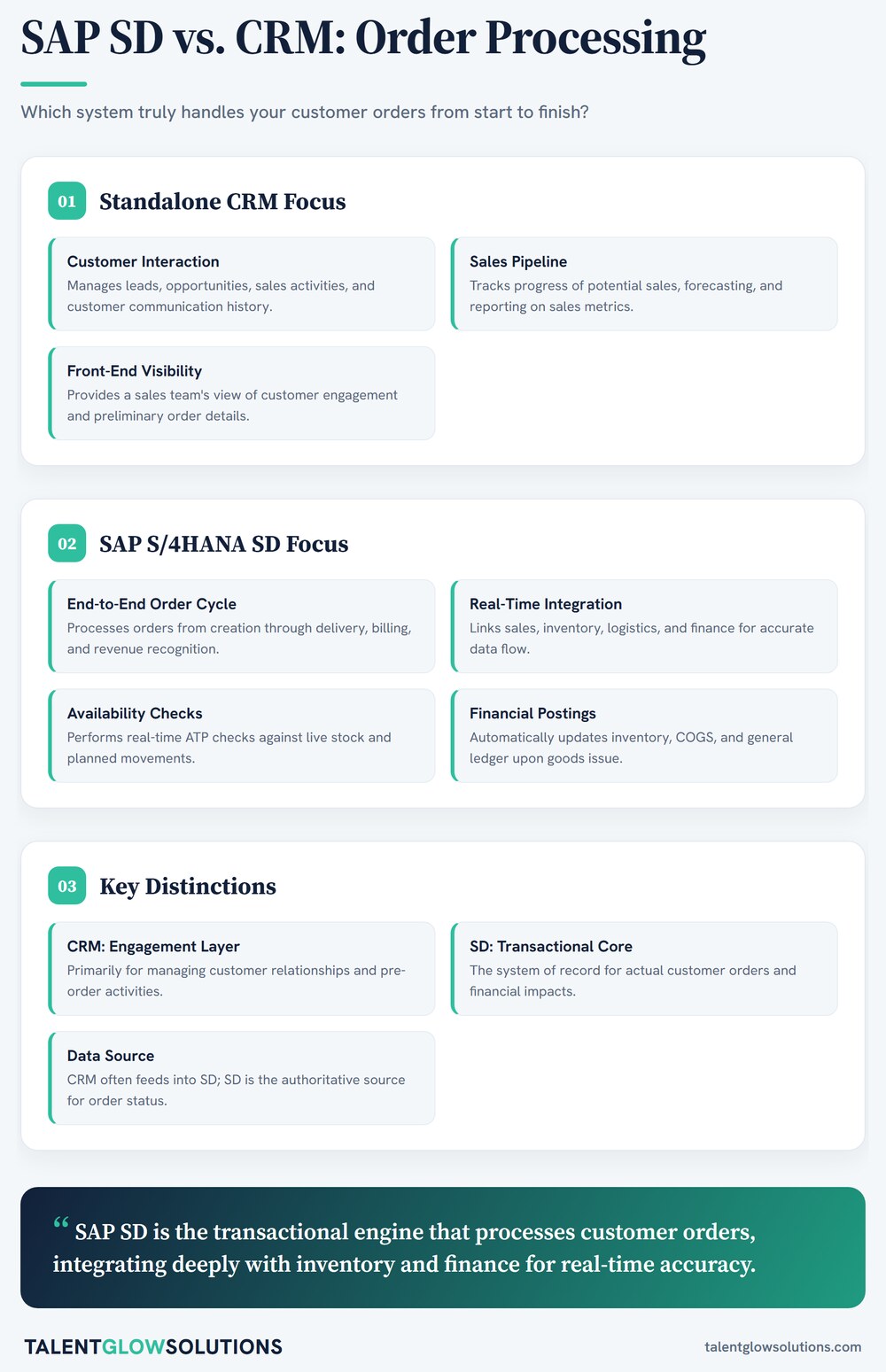
A standalone Customer Relationship Management (CRM) system primarily focuses on managing customer interactions and the sales pipeline. It's designed to streamline communication, track leads, nurture opportunities, and report on sales activities. Think of it as the front-end tool for your sales team, providing a comprehensive view of customer engagement history and potential deals.
CRMs excel at recording customer data, managing contacts, scheduling follow-ups, and automating marketing tasks. They help sales teams build relationships and move prospects through the sales funnel up to the point of order creation. While a CRM might generate a preliminary sales quote or proposal, it typically doesn't handle the intricate, real-time operational aspects of fulfilling that order.
How Does SAP S/4HANA Sales (SD) Process Customer Orders?
SAP S/4HANA Sales (SD) is the primary system for processing customer orders, managing the entire order-to-cash lifecycle. This includes everything from the initial order creation through delivery, billing, and ultimately, revenue recognition. Unlike a CRM, SAP SD is deeply integrated with other core business functions like inventory management, logistics, and finance.
When a sales order is created in SAP S/4HANA SD, it triggers a series of integrated processes. These processes include critical steps such as pricing determination, real-time availability checking, delivery scheduling, and credit checks. This ensures that the order is not only captured but also validated against current business realities before fulfillment can proceed.
What are Real-Time Availability Checks (ATP) in SAP SD?
SAP SD performs real-time availability checks (ATP - Available To Promise) against various stock categories. This is a crucial distinction from most CRMs, which typically don't have direct access to live inventory data. SAP SD checks current warehouse stock, planned inward movements (like production orders or purchase orders), and planned outward movements (such as existing sales orders or deliveries).
This real-time capability ensures that customers are only promised goods that are actually available or will be available by the requested delivery date. It prevents over-selling and provides accurate delivery commitments, directly impacting customer satisfaction and operational efficiency. Without this, a sales team might promise stock that isn't there, leading to costly backorders and frustrated customers.
How Does SAP SD Integrate with Inventory and Finance?
The integration between SAP SD, inventory, and finance is a cornerstone of its functionality. Upon goods issue (when products leave the warehouse), SAP SD automatically reduces inventory levels in real-time. Simultaneously, it records the cost of goods sold and updates the general ledger, ensuring financial accuracy.
Furthermore, billing documents generated within SAP SD automatically create corresponding financial documents in Financial Accounting (FI). This direct link ensures that every sale is properly accounted for, from a logistical and financial perspective, without manual intervention or reconciliation. This seamless integration is why SAP SD is considered the system of record for order processing.
Comparison: SAP SD vs. Standalone CRM for Order Processing
To summarize the core differences, consider this comparison:
| Feature | Standalone CRM | SAP S/4HANA SD |
|---|---|---|
| Primary Function | Customer relationship management, sales pipeline | End-to-end order processing, order-to-cash cycle |
| Order Creation | Captures preliminary order details, quotes | Creates and manages actual sales orders |
| Inventory Check | Typically no real-time stock access | Performs real-time ATP checks against live stock |
| Financial Impact | No direct ledger postings | Automatically updates inventory, COGS, and GL |
| Logistics Integration | Limited or none | Deeply integrated with delivery and shipping |
| Billing | May generate invoices, but not financial docs | Generates billing documents, creates FI postings |
| System of Record for Order | No, typically a front-end tool | Yes, the authoritative system for order data |
This table illustrates that while a CRM facilitates the sales process, SAP SD executes the transactional core of the customer order. For businesses that rely on accurate inventory, streamlined logistics, and precise financial reporting, SAP SD is indispensable.
Why is SAP SD Essential for Businesses?
SAP SD's essentiality stems from its comprehensive handling of the entire sales and distribution process. It provides a single source of truth for all sales-related data, ensuring consistency and accuracy across departments. This reduces errors, speeds up order fulfillment, and improves cash flow by automating billing and revenue recognition.
For businesses scaling up or dealing with complex product catalogs and customer demands, SAP SD offers the robust functionality required to manage high volumes and intricate business rules. It's the backbone that ensures customer promises are met efficiently and profitably. Understanding this distinction is key for hiring managers seeking professionals who can truly drive operational excellence in sales.
How Can You Develop Expertise in SAP SD?
Developing expertise in SAP SD is crucial for individuals looking to manage complex sales and distribution processes effectively. Comprehensive training on a live S/4HANA system, guided by experienced mentors, can provide the practical skills needed. This approach allows learners to engage with real-world scenarios, from sales order creation to delivery and billing processes.
TalentGlowSolutions offers mentor-led, project-based training across various SAP modules, including SAP SD, FICO, MM, PP, EWM, BASIS, and ABAP. Our programs focus on practical application and provide 100% placement assistance, though we do not guarantee a job. This support helps learners prepare for a career where they can proficiently manage critical business functions using SAP S/4HANA.
Conclusion
While a standalone CRM is invaluable for managing customer relationships and nurturing leads, it's SAP S/4HANA Sales (SD) that actually processes the customer order, verifying stock, scheduling deliveries, and impacting financial ledgers in real-time. For businesses, understanding this distinction is vital for selecting the right technology and hiring the right talent to ensure efficient, accurate, and profitable order fulfillment. Professionals skilled in SAP SD are equipped to manage the true transactional core of a company's sales operations.
Sources
- learning.sap.com :: https://learning.sap.com/products/supply-chain-management/sales
- cromacampus.com :: https://www.cromacampus.com/blogs/how-the-sales-order-process-works-in-sap-sd/
- help.sap.com :: https://help.sap.com/docs/SAP_ERP/04ed152d92884a6da49c778a13aecb21/5a63b753128eb44ce10000000a174cb4.html
- sapbwconsulting.com :: https://www.sapbwconsulting.com/blog/sap-sd-order-to-cash
Frequently asked questions
Can a CRM perform real-time stock checks?
Generally, standalone CRMs do not perform real-time stock checks. They are designed for customer interaction and sales pipeline management. SAP SD, however, performs real-time Available To Promise (ATP) checks against live inventory and planned movements.
Does a sales order in a CRM update financial records?
A sales order created in a CRM typically does not directly update financial records or the general ledger. In SAP S/4HANA SD, billing documents automatically create corresponding financial documents in Financial Accounting (FI) upon goods issue, ensuring real-time financial postings.
What is the order-to-cash process in SAP SD?
The order-to-cash process in SAP SD covers the entire lifecycle from customer order creation through delivery, billing, and revenue recognition. It involves integrated processes like pricing, availability checks, delivery scheduling, and credit checks across sales, inventory, logistics, and finance.
Is SAP SD a replacement for a CRM?
SAP SD is not a replacement for a CRM; rather, they serve different but complementary functions. A CRM focuses on customer engagement and lead management, while SAP SD is the transactional system that processes the actual orders and integrates with core business operations like inventory and finance.
Why is integration important between sales and finance systems?
Integration between sales and finance systems is crucial for accuracy and efficiency. In SAP SD, upon goods issue, inventory levels are reduced, the cost of goods sold is recorded, and the general ledger is updated automatically. This real-time integration prevents discrepancies, reduces manual effort, and provides an accurate financial picture of sales transactions.
Ready to launch your career?
Propel your career forward by mastering SAP SD with mentor-led training and dedicated placement assistance at TalentGlowSolutions.
Explore Programs Talk to us